
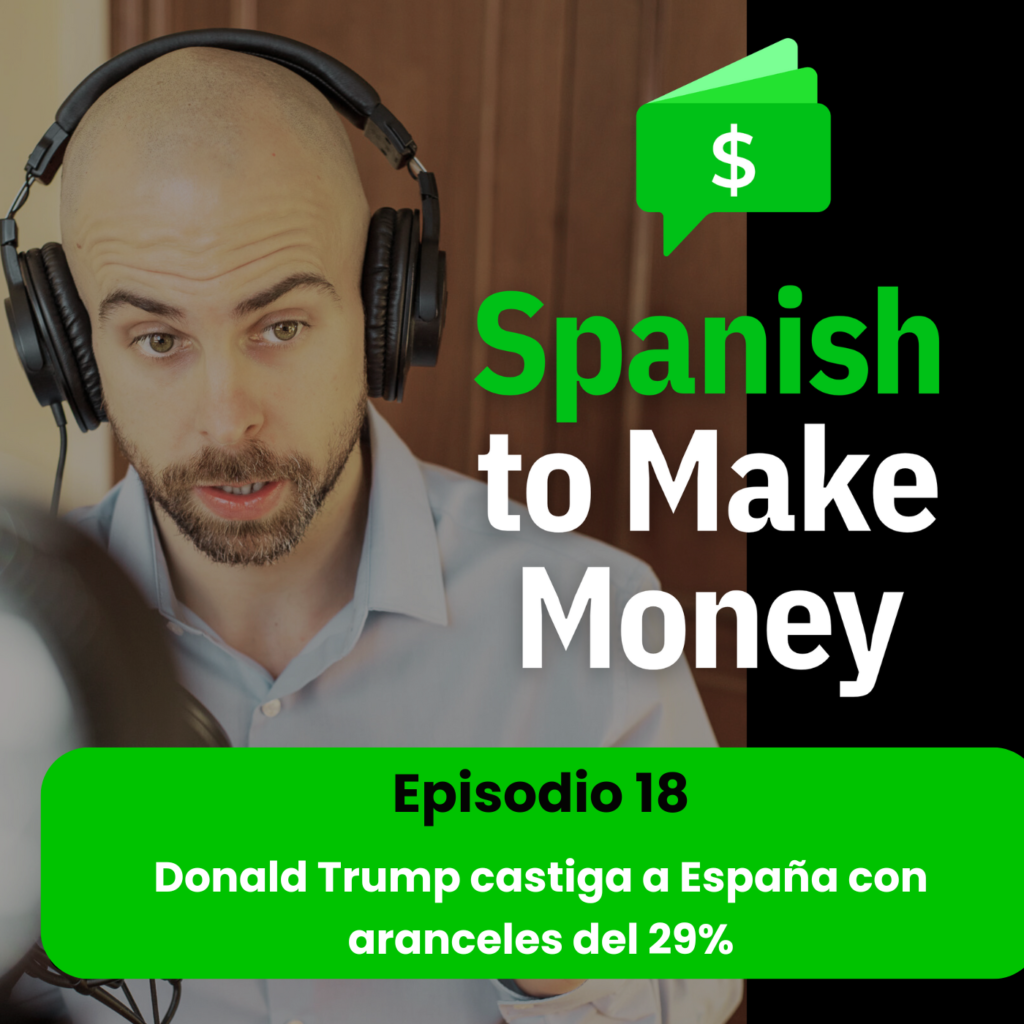
In today’s podcast, we immerse ourselves into the interesting issue of tariff rates in Spanish, with a special spotlight on the latest news that Donald Trump has imposed a whopping 29% tariff on Spanish wind energy companies.
Remember that I record a podcast every week to help business professionals to improve their Spanish to make more money in their businesses.
¿How?
Talking about news article related to business every week in order to increase your Spanish vocabulary and understanding critically important business-economic ideas of Spanish-speaking culture.
Listen to this episode (100% in Spanish) and go in-depth on tariff rates in Spanish (aranceles):
News background: Trump’s tariff on Spain
On February 10, the business world’s eyes were drawn to a sensational headline: Donald Trump has now imposed a very high 29% tariff on Spanish companies that manufacture wind energy equipment (energía eólica).
The choice is purely not simply a political one, but has to be considered as the wind turbine (turbinas eólicas) wind energy storage sectors of the United States and Spain. The companies are facing the tariff such as Siemens Gamesa and Windar, which are both very important for the wind energy infrastructure in Spain.
Trump’s Commitment to Tariffs
During Trump’s term, he showed unwavering dedication to the protection of American industries from foreign companies through tariffs.
As he took office, one of the commitments he made was to impose tariffs on foreign companies (compañías extranjeras), and he has adhered to it.
The main reason for this policy is to increase production in the country by increasing the costs of foreign products (productos extranjeros), and this will in turn persuade people to buy domestic goods (productos nacionales).
The Justification Behind Tariffs
Trump believes that these tariffs are a «fair measure» (medida justa) intended to set the same rules for all companies in the market.
He insists that foreign companies’ often selling their products at lower prices than U.S. companies is a common practice, which is referred to as dumping.
He asserts (afirma) that this action affects the American companies and causes them to let go of their employees. By placing tariffs (al imponer aranceles), the aim is to defend the American jobs and reenergize the economy.
How to say Tariff Rates in Spanish and what is it?
A tariff (arancel) is a government tax imposed on the imported goods (bienes importados).
This tax is applied to each and every product entering the territory of a new country.
The underlying agenda of the tariffs is to increase the price of foreign products (incrementar el precio de los productos extranjeros), which will thus be less competitive (menos competitivos) compared to the locally made ones.
Through the lens of business, tariffs may be referred to as a shield for the local manufacturers (como un escudo para los productores locales).
How Tariffs Affect Prices
The imposition of tariffs affects prices in a number of direct ways.
When a tariff is put on (Cuando se impone un arancel), the cost of importing goods goes up (sube), which sometimes entails passing the costs to consumers through higher prices on the products.
The firms that use raw materials (materias primas) from other countries may also deal with increased production prices, thus, they are in a position to increase the price of their manufactured goods too.
The consequence of this could be inflationary pressure (presión inflacionaria) in the economy.
- Increased cost of imported goods
- Higher production costs for domestic companies (compañías locales o nacionales)
- Potential for inflation as prices rise
Spain and the Wind Energy Sector
Solar power (La energía solar) is a key part of the transformation in energy in Spain from nonrenewable to renewable sources (energías no renovables a energías renovables).
Siemens Gamesa, Windar, and other companies today are the ones producing wind turbines which use the power of wind, a natural, sustainable resource (energía sostenible), to produce energy.
Nevertheless, the latest tariffs that were slapped by the U.S. government have the potential to seriously damage this important sector.
Emphasizing the development of clean energy, Spain has made substantial investments (inversiones considerables) in wind energy technology thus positioning itself among the forefront countries (vanguardia de países) in this specific area.
The duties have not only increased the expense for these companies; they also pose a risk to their global competitiveness. Hence, because of this, the wind power sector in Spain has to tackle the newly arisen issues in order to secure the same market share.
Understanding Dumping Practices
Dumping is when corporations discharge their products in overseas markets (mercados extranjeros) below the price (por debajo del precio) they offer to their local consumers.
This strategy can decrease the local manufacturers’ profits (beneficios) and is typically regarded as a form of unfair competition (competencia desleal).
Refering to the Spanish wind energy industry, the U.S. government of the opinion that companies such as Siemens Gamesa and Windar have been participating in dumping, resulting in the setup of tariffs.
The Legal Battle Over Tariff Rates
The introduction of tariffs has led to a legal dispute between the U.S. government and Spanish wind energy firms (empresas españolas de energía eólica).
At first, Trump suggested an incredible 73% tariff, such a proposal was vigorously contested. Siemens Gamesa and Windar challenged this ruling (aceptaron el reto), stating that the arithmetic applied for the calculation of the dumping marginals was incorrect.
Favorable to the principle dumping margin, however, the U.S. judge who scrutinized the entire case has finally decided that the appropriate dumping margin is almost 29%, hence, the current tariff rate is close to this.
This legal tug-of-war (tira y afloja) is a good example of the international trade laws being complicated and the impact they can have on the companies on both sides of the Atlantic Ocean.
Deja una respuesta